

TL;DR: Helsinki plant rooms get standalone photoelectric coverage without cabling
Wanlin ships the WANLIN-307 standalone photoelectric smoke alarm from its Shenzhen line to Helsinki and Finland as a source-factory programme for distributors, importers, electrical wholesalers, fire protection contractors and private-label owners. The paperwork now travels with the pallet, and that is what changed the conversation.
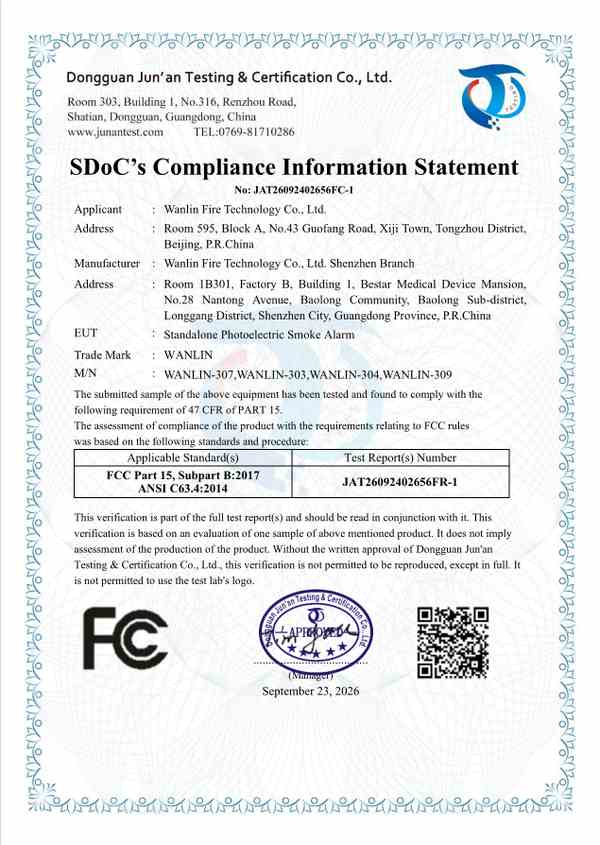
In short: buyers searching for EN 14604 Standalone Smoke Alarm in Helsinki are not shopping for a gadget, they are buying a document trail. On September 23, 2026 Wanlin completed a Supplier's Declaration of Conformity numbered JAT26092402656FC-1 for the Standalone Photoelectric Smoke Alarm, tested against FCC Part 15, Subpart B:2017 under procedure ANSI C63.4:2014 and recorded in test report JAT26092402656FR-1. That file covers conducted and radiated emission as a Class B unintentional radiator. It does not cover radio module authorization and it does not cover EN 14604 or UL 217 life-safety performance, and both are separate documents a buyer should request by name.
- Declaration: SDoC JAT26092402656FC-1, issued September 23, 2026
- Report: JAT26092402656FR-1, 24 pages, test window 2026-09-11 to 2026-09-19, issued 2026-09-19
- Standard: FCC Part 15, Subpart B:2017, procedure ANSI C63.4:2014, Class B limits
- Verdicts: conducted emission PASS, radiated emission PASS
- Equipment: Standalone Photoelectric Smoke Alarm, DC 3 V, models WANLIN-307, WANLIN-303, WANLIN-304 and WANLIN-309
- Configuration for this programme: LoRaWAN standalone - LoRaWAN Class A uplink on 868 / 915 MHz with multi-year battery life on the sealed cell
- Desk: wanlinfirecontrol@163.com / +8613261677119 / www.wanlinfire.com
Anyone can print a mark on a carton. Fewer can hand over the report behind it.
Helsinki, October 13, 2026: Why This File Matters More Than the Brochure
Reported from the Wanlin export desk in Shenzhen - Helsinki plant rooms get standalone photoelectric coverage without cabling. The reason this story is being written from a factory floor in Shenzhen rather than a distributor's showroom in Finland is simple: the questions arriving in the export inbox have changed shape. Six months ago the first question was price. Now the first question is which report number sits behind the product, and the second is whether that report can be sent as a file rather than described in an email.
Standalone smoke alarms are a low-margin, high-volume, heavily regulated product. A distributor in Helsinki who gets the paperwork wrong does not lose a margin, they lose a container at the border and a retail listing with it. That is why warehouse and plant room coverage with standalone units has become the practical starting point for every serious enquiry this year.
Wanlin is a source manufacturer, not a trading desk. The WANLIN-307 leaves the Longgang line with the declaration, the test report, the manual set and the packing list named on the quote, so that a compliance officer in Finland can check them before the money moves.
What the SDoC Covers - and What It Does Not
The most common misunderstanding in this product category is treating a Supplier's Declaration of Conformity as if it were a certificate issued by somebody. It is not. It is a declaration by the responsible party, supported by a test report, and its scope is printed on its face.
| Question | Answer on JAT26092402656FC-1 |
|---|---|
| What is declared | Standalone Photoelectric Smoke Alarm, trade mark WANLIN, models WANLIN-307, WANLIN-303, WANLIN-304 and WANLIN-309 |
| Which rule | FCC Part 15, Subpart B:2017 (47 CFR Part 15, Subpart B) |
| Which procedure | ANSI C63.4:2014 |
| Which report | JAT26092402656FR-1, issued 2026-09-19 |
| What was assessed | Conducted emission at the mains port and radiated emission at 3 m |
| Who tested | Dongguan Jun'an Testing & Certification Co., Ltd., Room 303, Building 1, No.316, Renzhou Road, Shatian, Dongguan, Guangdong, China |
| Who declared | Wanlin Fire Technology Co., Ltd., Room 595, Block A, No.43 Guofang Road, Xiji Town, Tongzhou District, Beijing, P.R.China |
| Who built | Wanlin Fire Technology Co., Ltd. Shenzhen Branch |
| What it is NOT | Not a radio module grant, not an EN 14604 type test, not a UL 217 listing |
The statement itself carries the limits of its own claim: it is based on an evaluation of one sample, it does not imply assessment of the production of the product, and it has to be read together with the full test report. A buyer who reads those two lines understands what they are holding.
Inside Test Report JAT26092402656FR-1
The report runs to 24 pages and is structured the way an EMC report should be: certification page, summary, test site, EUT description, methodology, setup, conducted emission, radiated emission, photographs of the equipment, and the labelling and user-information requirements that follow from the rule.
| Field | Recorded value |
|---|---|
| Report number | JAT26092402656FR-1 |
| Product | Standalone Photoelectric Smoke Alarm |
| Model | WANLIN-307 (family listing also covers WANLIN-303, WANLIN-304 and WANLIN-309) |
| Applicant | Wanlin Fire Technology Co., Ltd. |
| Manufacturer | Wanlin Fire Technology Co., Ltd. Shenzhen Branch |
| Trade name | WANLIN |
| Test date | 2026-09-11 to 2026-09-19 |
| Issue date | 2026-09-19 |
| Applicable standard | FCC Part 15, Subpart B Class B |
| Procedure | ANSI C63.4:2014 |
| Test engineer | Tanac |
| Technical manager | Tim You |
| Overall verdict | Pass on both emission items |
A buyer should notice three things here. The model on the report matches the model on the quote. The test window is dated, so the report has an age. And the report covers one sample of one model - which is exactly why production consistency is a separate question a factory has to answer with process, not with paper.
Conducted Emission: What Was Measured and Against Which Limit
Conducted emission is measured at the mains port, scanning from 150 kHz to 30 MHz on both the line and the neutral conductor, and recording at least the six highest emissions. For a battery device such as this one the practical result is that the unit is clean on the port it uses, but the method still has to be followed and recorded.
| Frequency band | Class B quasi-peak dB(uV) | Class B average dB(uV) |
|---|---|---|
| 0.15 - 0.5 MHz | 66 to 56 | 56 to 46 |
| 0.5 - 5.0 MHz | 56 | 46 |
| 5.0 - 30.0 MHz | 60 | 50 |
On this unit the conducted scan was run at 24.3 C, 54.1 percent RH and 101.1 kPa with a 6 dB bandwidth of 200 Hz / 9 kHz, in Working mode, and recorded as Pass by the engineer on the bench. The report also records the correction chain: reading level, correction factor, level, limit and the margin over the limit.
Radiated Emission at 3 Metres
Radiated emission is the item that matters for a device that spends its life on a ceiling near other electronics. The scan runs from 30 MHz to 1000 MHz with the antenna 3 m away, the turntable rotated through 360 degrees and the antenna height searched from 1 to 4 m in both vertical and horizontal polarization, with the quasi-peak reading reported.
| Frequency band | Class B limit at 3 m, dB(uV/m) |
|---|---|
| 30 - 88 MHz | 40.00 |
| 88 - 216 MHz | 43.50 |
| 216 - 960 MHz | 46.00 |
| 960 - 1000 MHz | 54.00 |
The radiated scan on this unit was run at 24.0 C, 55.1 percent RH and 101.2 kPa with a 120 kHz 6 dB bandwidth, in Working mode, and recorded as Pass. Both polarizations are covered, which is what a buyer should look for: a single-polarity result is a partial result.
Measurement Uncertainty and What a Pass Actually Means
A pass line without an uncertainty figure is not a complete result. The report records the expanded uncertainty at approximately the 95 percent confidence level using a coverage factor of k = 2.
| Parameter | Uncertainty |
|---|---|
| Temperature | +/- 1 C |
| Humidity | +/- 5 percent |
| DC and low frequency voltages | +/- 3 percent |
| Conducted emission, 150 kHz - 30 MHz | +/- 3.60 dB |
| Radiated emission, 30 MHz - 1 GHz | +/- 4.76 dB |
| Radiated emission, 1 GHz - 18 GHz | +/- 4.44 dB |
| Instrument | Manufacturer / model | Calibration due |
|---|---|---|
| EMI test receiver | Rohde and Schwarz ESCI | Sep. 1, 2027 |
| Artificial mains network | Rohde and Schwarz L2-16B | Sep. 1, 2027 |
| Artificial mains network | Rohde and Schwarz ENV216 | Sep. 1, 2027 |
| Bilog antenna | SCHWARZBECK VULB 9168 | Sep. 1, 2027 |
| Preamplifier | SCHWARZBECK BBV 9475 | Sep. 1, 2027 |
| Spectrum analyzer | Agilent E4407B | Sep. 1, 2027 |
| Horn antenna | SCHWARZBECK 9120D | Sep. 1, 2027 |
| Low noise amplifier | ZHINAN ZN3380C | Sep. 1, 2027 |
The point of publishing this table is not decoration. A compliance officer in Helsinki can check the calibration dates, and a factory that keeps its instruments in calibration is a factory that treats results as results rather than as marketing.
The Equipment on the Bench: DC 3 V, One Port, Working Mode
The EUT description in the report is short and tells you what kind of product this is: a standalone photoelectric smoke alarm running at DC 3 V with 0 AC ports and 1 DC port. Both emission tests were run in Working mode - the mode the unit sits in on a ceiling - rather than a standby or shipping mode, which is the honest choice.
What that means commercially matters for Finland. A battery device with no mains port has a small conducted-emission exposure, but it still has a radiated profile because it contains a switching circuit and, in the connected configurations, a radio. The declaration covers the unit as an unintentional radiator. When the unit carries a radio, the radio has its own authorization and its own file, and that is the next section.
Labelling Under Section 15.19 and the E-Label Question
The report restates the labelling rule: a device subject to a Supplier's Declaration of Conformity has to carry the compliance statement in a conspicuous location, and devices under the SDoC route may carry the FCC logo on a voluntary basis. The exact statement reads:
"This device complies with part 15 of the FCC Rules. Operation is subject to the following two conditions: (1) This device may not cause harmful interference, and (2) this device must accept any interference received, including interference that may cause undesired operation."
The report also records the conditions attached to electronic labelling: the information has to be clearly legible without the aid of magnification, and it must not be removable or modifiable by anyone other than the responsible party. For a ceiling-mounted alarm with no display, the practical answer is a physical label on the housing plus the statement inside the manual - and that is what Wanlin ships.
Information to the User: 15.21, 15.105 and the US Responsible Party
Two further obligations follow the declaration, and importers in Finland are the ones who end up owning them.
| Requirement | What it means for the importer |
|---|---|
| Compliance information statement supplied with the product | Product identification, the compliance statement, and the name, address and contact of the responsible party |
| Responsible party located in the United States | The named responsible party must be inside the USA - a commercial decision the importer makes before the first shipment |
| Section 15.21 caution in the manual | The manual must warn that changes or modifications not expressly approved could void the user's authority to operate the equipment |
| Section 15.105 Class B note | The manual carries the Class B digital device note, including the interference remedies list |
| Reproduction of the report | The report may not be reproduced except in full, and the laboratory logo may not be used |
a freight forwarder handling China-Europe safety goods put it this way: "Batteries inside the device change the paperwork. Lithium cells shipped inside equipment need the right declaration on the booking, or the container waits."
Document Checklist to Request Before Any Payment
This is the list Wanlin recommends an importer in Helsinki send to any factory, including this one. It is deliberately written so that a weak answer is obvious.
| Document | What to check on it |
|---|---|
| SDoC statement | Number JAT26092402656FC-1, issue date, model list, named responsible party |
| Full test report | Number JAT26092402656FR-1, 24 pages, test window, both verdicts, signatures |
| Model identity | The model on the report is the model on the device label and on the quote |
| Life-safety type test | EN 14604 or UL 217 report requested by name, if the destination market requires it |
| Radio module authorization | Module make, module grant, and the band configured for the destination |
| Battery declaration | Cell type, service life, and the shipping declaration for cells contained in equipment |
| Manual set | Languages, the 15.21 caution and the 15.105 Class B note |
| Packing list | Count per master carton, carton marking, pallet pattern |
| Warranty and spares | Warranty term, DOA policy, spare bases and chambers availability |
How to Read the Declaration and the Report Side by Side
A declaration is one page; a report is 24. The useful skill is knowing which line on the first page has to agree with which line in the file. This is the cross-check a compliance officer in Helsinki can run in ten minutes.
| Line on the declaration | Where to confirm it in the report | What a mismatch means |
|---|---|---|
| Model number | Certification page and EUT description | The declaration may not cover the unit being quoted |
| Applicant and manufacturer | Certification page addresses | The factory of record is not the seller of record |
| Standard and procedure | Applicable standards field and the method sections | An older procedure may not match the rule cited |
| Test date and issue date | Certification page | The report has an age; ask what changed since |
| Verdict | Test summary page | A pass on one item is not a pass on both |
| Report number | Footer of every page | A mismatched number means the file is not the file |
The last row is the one people skip. Every page of report JAT26092402656FR-1 carries the number in its footer, and a supplier who sends a re-typed summary instead of the report is telling the buyer something useful.
Radio Modules Are a Separate Authorization - Ask for the Grant
This is where most first-time importers get caught. The SDoC covers the product as an unintentional radiator. The moment a 4G, NB-IoT, LoRa, 433 MHz or Wi-Fi module is fitted, that module is an intentional radiator with its own authorization, and the host integration has to be considered.
| Configuration | Authorization question | What to ask the factory |
|---|---|---|
| LoRaWAN standalone | Regional parameters and band plan | Which band is configured, and is it the band used in Finland |
| 4G Cat-1 standalone | Module grant and operator approval | Which module is fitted, which grant it holds, which operators are supported |
| NB-IoT standalone | Band and roaming arrangement | Which bands are enabled and how the SIM is provisioned |
| 433 MHz RF interconnect | Regional sub-band allocation | Which sub-band, and what the duty cycle rules are locally |
| Wi-Fi or Zigbee variant | Module grant and host integration | Module grant number and the host assessment statement |
None of this is a reason to avoid a connected unit. It is a reason to specify it in writing. Wanlin answers the module question on the first email because a buyer who discovers it at customs is a buyer who never orders again.
One Statement, Four Model Numbers
The declaration lists WANLIN-307, WANLIN-303, WANLIN-304 and WANLIN-309. That is useful for a buyer running a range, but it is not a blank cheque: the model on the device label has to appear on the statement, and the type-test report has to name the model being imported.
| Model | Position in the range | Typical buyer |
|---|---|---|
| WANLIN-307 | Wireless standalone with LoRaWAN, 4G Cat-1 or NB-IoT uplink | Distributors, housing programmes, projects needing remote reporting |
| WANLIN-303 | Standalone photoelectric with 433 MHz RF interconnect | Wholesalers, landlords, room-by-room retrofit |
| WANLIN-304 | Companion standalone configuration in the same family | Buyers consolidating a range under one file |
| WANLIN-309 | Networked photoelectric detector for panel or cloud hosts | System integrators and estate projects |
Anatomy of the WANLIN-307
A standalone alarm is a small number of decisions stacked on top of each other. Here is what is inside the housing and why each line is on the specification.
| Element | Specification | Why it matters |
|---|---|---|
| Sensing chamber | Photoelectric chamber with drift compensation and automatic self-check | Slow smouldering fires are the common case in housing |
| Sounder | Onboard sounder rated 85 dB(A) at 3 m | The alarm has to be heard through a closed door |
| Indication | Red alarm LED, green standby and network blink | Status visible from the floor without a ladder |
| Controls | Front-face test and hush button | Maintenance without removing the head |
| Power | Long-life sealed lithium cell option with low-battery warning | Removes the annual battery round from the maintenance budget |
| Mounting | Twist-fit base for 60 - 110 mm mounting centres | Replaces most existing bases without new drilling |
| Housing | ABS V-0 white, 104 mm diameter, UV stabilised | Flame rating and colour stability over a ten-year life |
| Environment | Operating -10 to +55 C, 5 - 95 percent RH non-condensing | Coastal humidity and unheated plant rooms |
| Service | Removable chamber for cleaning, insect screen | Cleanable units survive humidity and cooking aerosol |
| Warranty | 3-year limited warranty, 30-day DOA replacement | Written term rather than a verbal promise |
Three Radio Configurations and How to Choose for Finland
| Configuration | How it behaves | Best fit |
|---|---|---|
| LoRaWAN standalone | LoRaWAN Class A uplink on 868 / 915 MHz with multi-year battery life on the sealed cell; alarm, fault and low-battery events reach the cloud dashboard with no panel and no gateway on site | Campuses, estates and housing blocks with a private network |
| 4G Cat-1 standalone | 4G Cat-1 cellular uplink for sites without LoRaWAN coverage, SIM provisioned per market, alarm and heartbeat events to the cloud with SMS and app alerting | Dispersed sites, small portfolios, markets without a local IoT network |
| NB-IoT standalone | NB-IoT narrowband uplink with deep indoor penetration for basements, plant rooms and stair cores, multi-year battery life and operator roaming options per country | Basements, underground parking, stair cores and plant rooms |
For this programme the configured variant is LoRaWAN standalone - LoRaWAN Class A uplink on 868 / 915 MHz with multi-year battery life on the sealed cell. Where coverage in Helsinki argues for the alternative, the factory can quote 4G Cat-1 standalone on the same housing, which keeps the label, the manual and the spares common across the range.
Battery Chemistry, Service Life and Shipping Rules
The cell decides the ten-year cost of a standalone alarm, and it is also the part that complicates the freight booking. Both facts belong in the specification rather than in an afterthought.
| Question | What to specify | Why it matters |
|---|---|---|
| Cell type | Sealed long-life lithium cell with a stated service life, or a replaceable cell where local code requires it | Sealed cells remove the annual battery round; replaceable cells suit some landlord policies |
| Low-battery warning | Defined lead time before the cell is exhausted, with audible and visual indication | A warning with no lead time is a call-out waiting to happen |
| End-of-life behaviour | Stated end-of-life indication and replacement age | Landlord programmes need a dated replacement plan |
| Air freight | Cells contained in equipment declared on the booking | Undeclared cells stop a shipment at the airline |
| Sea freight | Battery declaration matched to the packing list | Carrier documentation has to agree with the carton count |
| Storage | Temperature and humidity limits for warehouse stock | Cell self-discharge rises with storage temperature |
Wanlin states the cell type on the quote and packs the battery declaration with the shipment, because a container waiting on a declaration is the most expensive kind of delay in this product category.
Standalone, Interconnected or Networked
The word standalone is doing real work in this product category, and buyers in Finland are right to pin it down before ordering.
| Mode | What happens on alarm | Installation load | Who buys it |
|---|---|---|---|
| Standalone | The unit that detects sounds its own sounder; nothing else is required | One device per location, no commissioning | Landlords, wholesalers, retail shelf |
| Interconnected | One detection sounds every unit in the group | RF group binding at commissioning | Houses, small blocks, student units |
| Networked | Detection is reported to a panel or cloud host that commands the group and logs the event | Device addressing, zone assignment, dashboard setup | Estates, hotels, industrial sites |
The honest advice for a distributor in Helsinki is to sell the mode the channel can support. A counter that cannot support a gateway sale should be selling standalone units, and a project team that needs an event log should be buying networked ones.
Siting Rules and Nuisance Alarm Control
Most nuisance alarms are a siting problem, not a sensor problem. A photoelectric chamber is the right choice for smouldering fires, which is the common residential case, but it still has to be mounted where cooking aerosol, steam and dust do not reach it every day.
| Location | Practical rule | Reason |
|---|---|---|
| Sleeping rooms and escape routes | Ceiling mounted, central where possible | Smoke reaches the ceiling first along the escape route |
| Kitchens | Away from the cooking appliance, not directly above it | Cooking aerosol is the single largest nuisance source |
| Bathrooms | Outside the door rather than inside | Steam produces avoidable alarms |
| Garages and plant rooms | Specify the temperature range and dust protection | Exhaust and dust shorten service life |
| Sloped ceilings and apexes | Follow the local code distance from the apex | Stagnant air pockets delay detection |
| Near fans and air supplies | Keep clear of supply diffusers | Dilution delays the alarm |
Where a location cannot avoid nuisance sources, the specification should require a hush function, a tuned chamber response, and a removable chamber that can be cleaned rather than replaced. Those three lines appear on the WANLIN-307 specification for exactly this reason, and they are what keeps a housing officer in Helsinki off the phone.
Standards Map: Which File Belongs to Which Question
| Standard or rule | Scope | What it answers | Where it applies |
|---|---|---|---|
| EN 14604 | Smoke alarm devices for standalone household use | Type test of the alarm function, sounder, battery and durability | EU and many national housing codes |
| EN 54-7 | Smoke detectors - point detectors using scattered light | System detector performance when the unit is part of a fire system | EU system installations |
| EN 54-25 | Components using radio links | Radio path integrity and fault behaviour of wireless system components | EU wireless system installations |
| UL 217 | Standard for smoke alarms | North American smoke alarm type testing including fire and nuisance sources | USA and Canada |
| UL 268 | Smoke detectors for fire alarm systems | System detector type testing | USA and Canada system work |
| BS 5839-6 | Fire detection in dwellings | Grading, siting and power supply practice | UK housing and landlord work |
| ISO 7240 | Fire detection and alarm systems | International system parts series | International tenders |
| FCC Part 15 Subpart B | Unintentional radiators | EMC emissions: conducted and radiated, Class B limits | USA import and marketing |
| RoHS / REACH | Substance restrictions | Materials declaration for the EU market | EU and UK |
| National approvals | Civil defence, SABER, SASO, BIS and similar | Country-specific registration before import | Gulf, India and other regulated markets |
A buyer should not accept one document as an answer to all four questions. EMC evidence, radio authorization, life-safety type testing and national registration are four separate files, and a factory that can send all four is a factory worth a container.
Where Standalone Units Actually Get Installed
| Application | Siting | Specification that matters | Reference model |
|---|---|---|---|
| Short-term rental properties | each sleeping room and escape route | quick install, sealed cell, low-battery warning | WANLIN-307 LoRaWAN standalone |
| Landlord and rental units | one unit per habitable room plus hallway | sealed 10-year cell, hush button, removable chamber | WANLIN-307 LoRaWAN standalone |
| Senior living and assisted living | bedroom, living area and escape route | voice or strobe options, remote fault reporting | WANLIN-307 4G standalone |
These three siting patterns cover most of the standalone volume leaving Shenzhen for Finland. The common factor is that none of them wants a panel, a gateway or a cable run - which is exactly what a standalone unit removes from the job.
Field Report: carton-open check against the SDoC model list
In Helsinki the check that decides whether a shipment is accepted is usually done by whoever has to maintain it afterwards, not by whoever signed the order. The scene: the buyer's warehouse team opens one carton, reads the label and checks the model number against the statement before the rest of the pallet is broken down.
"We stopped unpacking pallets blind after we had to re-label two shipments. One carton, one label, one check against the statement, then the rest of the load."
What the crew recorded on the sheet: label model number matches the statement, carton count matches the packing list, manuals in the language ordered. Those three lines are what a maintenance team can actually act on, and they are the reason the specification is written the way it is.
Maintenance Regime: Test, Log and Replacement Cycle
A standalone alarm is a ten-year maintenance commitment, and the buying decision should be made against that commitment rather than against the unit price.
| Interval | Action | Record kept |
|---|---|---|
| Monthly | Press the test button and confirm the sounder and LED | Block log entry with unit identification |
| Quarterly | Visual check of the housing, chamber screen and mounting | Cleaning record where the chamber is opened |
| Annually | Confirm the low-battery indication and the alarm memory | Annual compliance record for the landlord file |
| On event | Read the alarm memory and the event history | Incident record with date and location |
| On fault | Remote diagnostics where the unit reports, bench check where it does not | Fault and rectification record |
| At end of life | Replace the head on the existing base | Replacement date against the stated service life |
The last row is where a twist-fit base earns its keep: a replacement head goes onto an existing base in minutes, with no new drilling and no redecoration. That is what makes a ten-year replacement programme affordable for a housing operator in Helsinki.
From Search to First Container: the Path a Buyer in Helsinki Takes
Most first orders in this category follow the same seven steps. The timings below are the ranges a sourcing team should plan against, not promises.
| Step | What happens | Typical duration |
|---|---|---|
| Search and shortlist | Buyer searches a product term and a country term, then shortlists factories that publish document numbers | 1-3 days |
| Technical enquiry | Buyer sends a specification sheet and asks for report numbers, module details and band configuration | 1-2 days |
| Document review | Compliance officer reads the SDoC, the test report and the life-safety type test, and checks model numbers match | 3-10 days |
| Sample carton | Sample carton shipped by air express, unpacked, benched and compared with the documents | 5-12 days |
| Factory audit | Buyer or agent audits the line, or reviews a video audit and the calibration records | 1-5 days |
| Trial order | Small production order used to confirm that the production carton matches the sample carton | 15-30 days |
| First container | Container booked with the right battery declaration, documents packed with the shipment | 25-45 days |
For Helsinki the sample leg is usually the quick part: air express counted in about 3 days once the carton is packed. The sea leg for the first container is counted in weeks, typically 22 days port to port depending on the routing, and the document review in between is what actually sets the date.
OEM, ODM and Private Label: What Can Actually Change
Private label is not a sticker, and the depth of the change drives both the MOQ and the lead time. This is the table Wanlin uses with programme buyers.
| Layer | What changes | Commercial effect |
|---|---|---|
| Carton and manual | Artwork, language set, packing count, barcode | Lowest MOQ, shortest lead time |
| Device label | Brand name, model number, compliance statement text | Low MOQ, artwork lock required |
| Housing colour and logo | ABS colour, pad print or moulded logo | Medium MOQ, tooling or print setup |
| Radio configuration | LoRaWAN, 4G Cat-1 or NB-IoT selection and band setting | Medium MOQ, per-market approval |
| Firmware behaviour | Heartbeat interval, alarm memory, hush timing, OTA policy | Higher MOQ, development time |
| Platform and app branding | Dashboard and alert wording under the buyer's brand | Highest MOQ, project scope |
A distributor in Finland starting a private-label programme should begin at the carton and manual layer, prove the sell-through, and only then move up to housing and firmware changes. That order keeps the money in the channel instead of in tooling.
Packing, Manuals and Language Sets
| Item | Content | Form |
|---|---|---|
| Device label | Model number, brand, compliance statement text, cell type, manufacture code | Printed on the housing |
| Carton print | Buyer artwork, barcode, quantity, language mark | Retail or plain carton |
| Manual set | EN, ES, FR, DE, IT, PL, AR and other languages on request | Printed, folded in carton |
| Quick-start card | Mounting, test, hush and battery warning | One card per unit |
| Master carton | Stated count per master carton, packed to the buyer's count | Palletised on request |
| Battery declaration | Lithium cells contained in equipment, declared on the booking | Freight paperwork |
The two items that cause the most grief at import are the manual language set and the battery declaration. Both are cheap to get right at the factory and expensive to fix at the destination.
Price Bands, MOQ, Incoterms and Lead Time
Wanlin does not publish a price list in an article, because the honest answer depends on configuration, quantity and packing. What can be published is the structure of the quote.
| Programme shape | Band | What drives it | Commercial note |
|---|---|---|---|
| Standalone battery unit, plain carton | Lowest band | Existing tooled product, factory carton | Lowest MOQ, fastest lead time |
| Standalone unit, private-label carton and manual | Low to mid band | Artwork and language set supplied by buyer | Low-to-medium MOQ |
| Wireless standalone with LoRaWAN configuration | Mid band | Band configuration and network parameters fixed | Medium MOQ |
| Cellular standalone with 4G Cat-1 or NB-IoT | Mid to upper band | SIM provisioning and operator parameters per market | Medium MOQ, operator dependent |
| ODM programme with housing and firmware changes | Upper band | Development, tooling and approval scope | Highest MOQ, staged delivery |
Quotes are issued FOB Shenzhen, EXW or CIF to the nominated port in Finland, with production lead time confirmed in writing at order - typically around 25 days for a repeat configuration and longer for a first private-label run. A sample quantity of 6 units can be prepared for air dispatch to Helsinki before the production slot is booked.
Source Factory or Local Distributor: Where the Money Goes
| Line | Source factory in Shenzhen | Local distributor in Finland |
|---|---|---|
| Unit price | Factory-direct price at the stated MOQ | Local distributor price with two margins applied |
| Document set | SDoC, test report and type-test files sent with the quote | Documents passed down, sometimes incomplete |
| Configuration | Band, cell and packing set per order | Stock configuration only |
| Private label | Available from carton level upward | Usually not available |
| Lead time | Production slots booked directly with the factory | Dependent on distributor stock |
| Technical support | Direct line to the engineering desk | Filtered through the distributor |
| Spare parts | Bases, chambers and cells stocked per project | Dependent on distributor policy |
Both models are legitimate. A buyer moving 18000 units a year is usually past the point where a distributor adds value on price, and not always past the point where a distributor adds value on local stock and credit terms. The right answer is often both: distributor for the urgent top-up, factory for the annual programme.
Five Ways This Kind of Sourcing Goes Wrong
- Treating an SDoC as a life-safety certificate. The declaration covers EMC emissions. Ask for the EN 14604 or UL 217 type-test report as a separate file, and check that the model number on the report is the model number you are buying.
- Forgetting that the radio module is a separate authorization. A 4G, NB-IoT or LoRa module carries its own grant. Ask which module is fitted, which grant it holds and whether the host integration was assessed.
- Not fixing the frequency band in writing. LoRaWAN regional parameters differ by country. A unit configured for the wrong band is a container of returns, not a small problem.
- Skipping the US responsible party question. Under the SDoC route the responsible party has to be located within the United States. Settle who that is before the first shipment, not after the first customs query.
- Buying the sample and not the production run. Keep carton one as a control sample. Compare label artwork, manual revision and packing count with the production carton before releasing the balance.
an EMC test engineer who has run Part 15 Subpart B benches, reviewing files for importers, was blunter about it: "Class B is the residential limit. A pass at 3 m with a quasi-peak detector is a statement about the device as tested, and the report says exactly that: the result relates to the sample tested."
Nine Questions to Ask Any Factory Before the First Order
- Which model numbers appear on the SDoC and on the type-test report you are sending me?
- Can you send the full test report rather than a summary page?
- Which radio module is fitted and which authorization does it hold?
- Which frequency band is the unit configured for, and is that the band used in my country?
- What is the stated service life of the cell, and what does the low-battery warning do and when?
- Is the chamber removable and cleanable, and what is the insect screen specification?
- What is the sounder output at 3 m, and has audibility been measured with the door closed?
- What changes in a private-label run, and what is the MOQ for each change?
- What is in the carton: device, base, fixings, cell, manual languages and the compliance statement?
Any factory that can answer all nine in writing within two working days is a factory worth a sample carton. One that answers three of them with a brochure is not.
How This Programme Compares on the Things Buyers Check
The comparison below is written without naming competitors, because the useful comparison is not brand against brand. It is what the supplier can put in writing.
| Check | Wanlin source-factory programme | Typical market alternative |
|---|---|---|
| Document trail | SDoC number and test report number published with the quote | Varies by supplier; often a mark on a carton only |
| Radio options | LoRaWAN, 4G Cat-1 and NB-IoT configured per market | Often one fixed configuration |
| Battery | Sealed long-life cell option with stated service life | Replaceable cell in many retail units |
| Maintenance | Removable chamber, low-battery warning with lead time | Varies; sealed units cannot be cleaned |
| OEM depth | Carton, label, housing, firmware and platform layers | Usually carton level only |
| Export paperwork | Battery declaration, manual languages, compliance statement text | Usually the supplier's home-market set |
Reading a Chinese Factory File Honestly
A buyer comparing a China source factory with a European or Japanese brand is not comparing quality in the abstract. They are comparing what can be evidenced. This is the frame Wanlin suggests using, and it works in both directions.
| Claim | Evidence to ask for | How to verify it |
|---|---|---|
| The unit is type tested | The life-safety type-test report naming the model | Check the model number and the laboratory named on the report |
| The unit is EMC compliant | SDoC JAT26092402656FC-1 and report JAT26092402656FR-1 | Read the verdicts and the test window on the certification page |
| The radio is authorized | Module grant and band configuration | Match the module make to the grant and the band to the destination |
| Production is consistent | Process records, calibration dates, control sample policy | Compare carton one with the production carton |
| The factory can support the product | Warranty term, spares stock, manual revision control | Ask for the spares list and the revision record |
| The price is real | Configuration, packing, Incoterms and quantity on the quote | Re-quote the same configuration from two suppliers and compare line by line |
Stated plainly: a China source factory wins on configuration depth, document turnaround and programme economics. A local brand wins on local stock, local warranty handling and shelf recognition. A distributor in Finland selling both is usually in the most profitable position.
Warranty, Spares and the After-Sales Programme
| Item | What the programme covers | Note for Finland |
|---|---|---|
| Warranty term | 3-year limited warranty against manufacturing defect | Term written on the quote, not implied |
| DOA policy | 30-day replacement for units dead on arrival | Claimed against the packing list and carton code |
| Spare bases | Twist-fit bases stocked per project | Keeps replacement heads interchangeable across an estate |
| Chamber cleaning kits | Kits stocked per project where maintenance is in-house | Suits coastal and high-humidity installations |
| Cells | Replacement cells where the specification uses a replaceable cell | Sealed-cell programmes replace the head instead |
| Documentation | Manual revision record and compliance statement text held on file | Re-orders match the original approved file |
| Technical desk | Direct engineering contact for configuration and commissioning questions | 24-hour response from the export desk |
The after-sales line that matters most for a distributor in Helsinki is the revision record. When a re-order arrives twelve months later with the same manual revision and the same label artwork, the compliance file does not have to be rebuilt.
Partner Profile: a hotel fit-out contractor in Helsinki
a hotel fit-out contractor working in Helsinki, specifying guest-room detection with a documented audibility check. The range under discussion covers WANLIN-307 LoRaWAN standalone, WANLIN-309 networked.
"Every guest room gets a unit, and every unit has to be heard through a closed door. We measure it."
The pattern is familiar across Finland: the buyer who wins is not the one with the lowest unit price, it is the one whose paperwork survives a compliance review and whose maintenance team can service the unit for ten years.
Cooperation Models Open to Partners in Finland
| Model | How it works | Who it suits |
|---|---|---|
| Country distributor | Exclusive or non-exclusive territory, stock held locally, marketing material and manual language sets supplied by the factory | Distributors with a fire safety or electrical wholesale channel |
| Importer and private-label owner | Factory ships under the buyer's brand with agreed artwork, carton and manual control | Retail chains, online brands, catalogue owners |
| OEM configuration programme | Radio configuration, housing colour, cell choice and packing defined per programme and locked by a specification sheet | Brands that need a repeatable annual programme |
| ODM development | Industrial design, chamber tuning, firmware behaviour and app or platform branding developed to a written brief | Buyers with a multi-year roadmap |
| Project contractor supply | Single-project quantities with documentation packs matched to the tender file | Housing programmes, hotel groups, campus projects |
| Sourcing agent and trading desk | Factory-direct pricing with the agent handling consolidation, documentation and onward shipment | Agents serving several small buyers at once |
Wanlin Manufacturing Group is recruiting local partners in Helsinki and across Finland: distributors, importers, fire protection contractors, electrical wholesalers, facility management groups, private-label owners, export trading companies and sourcing agents. Exclusive-territory discussions are open through the export desk.
Logistics and Coverage for Helsinki
Shipments for Finland are planned around Helsinki (Vuosaari) and Kotka for direct calls with bonded trucking into the Tampere industrial belt and feeder services from Tallinn and Stockholm. Standalone alarms are light and dense, so a container is usually limited by carton count rather than weight, and the two items that hold a booking up are the battery declaration and the manual language set.
Wanlin packs the document set with the shipment rather than emailing it afterwards: declaration, test report, packing list, manual revision record and the battery declaration. A customs broker in Helsinki should be able to clear the file without a second email.
Where This Product Category Is Heading
- Buyers are separating EMC evidence, radio module authorization and life-safety type testing into three different files, and asking for all three.
- Audibility with the door closed is being measured instead of assumed, especially in hotels and student housing.
- Lithium cells shipped inside equipment are driving earlier booking paperwork and more freight-forwarder involvement in the quotation stage.
- Sample cartons are being used as a control sample: buyers keep carton one and compare it with carton four hundred.
- Document-first buying: importers ask for the report number before the unit price, and suppliers who can answer in one email win the enquiry.
an electrical wholesaler branch manager put the direction in one line: "Shelf turnover decides the spec. If the unit needs a gateway and an app to be useful, it does not belong on my shelf next to the wiring accessories."
Frequently Asked Questions
Can the FCC label be electronic?
The report discusses electronic labelling conditions: the information has to be clearly legible without magnification and not removable or modifiable by anyone other than the responsible party. For a ceiling device with no display, the practical answer is a physical label on the housing plus the statement in the manual.
How fast can a sample carton reach Helsinki?
Air express to Helsinki is normally counted in days once the carton is packed; sea freight for the first container is counted in weeks. The sample is the fast part - the documentation review that follows it is what decides the schedule.
What is the test report number a buyer should ask for?
Ask for JAT26092402656FR-1. It is a 24-page report issued on 2026-09-19 by Dongguan Jun'an Testing & Certification Co., Ltd., with a test window of 2026-09-11 to 2026-09-19. A supplier that can send the report rather than describe it is the one worth shortlisting.
What battery specification should a buyer write down?
Sealed long-life lithium cell with a stated service life, a low-battery warning with a defined lead time, and a stated end-of-life behaviour. Write the cell type into the specification rather than accepting a generic 'battery included' line.
What does the FCC SDoC on the WANLIN-307 actually cover?
It is a Supplier's Declaration of Conformity numbered JAT26092402656FC-1 issued on September 23, 2026 for the Standalone Photoelectric Smoke Alarm. It states that the sample tested was found to comply with FCC Part 15, Subpart B:2017 under procedure ANSI C63.4:2014 as a Class B unintentional radiator, covering conducted emission at the mains port and radiated emission measured at 3 m.
What were the two verdicts in the test summary?
Conducted emission (main port): PASS. Radiated emission: PASS. Both were recorded against the Class B limits of FCC Part 15, Subpart B:2017, and the summary notes the verdict is decided by the limit of the test standard.
Which radio configuration should be chosen for a project?
LoRaWAN for campuses and estates with a private network, NB-IoT for basements and plant rooms needing deep indoor penetration, and 4G Cat-1 for dispersed sites with no local network. The frequencies available depend on the country of installation.
Is an SDoC the same as an FCC ID?
No. An SDoC is a declaration by the responsible party backed by a test report. An FCC ID is an equipment authorization issued for a radio transmitter. A battery smoke alarm with no intentional radiator is declared; the radio module inside a connected version carries its own authorization.
What voltage does the unit run on and what ports were tested?
The EUT is recorded at DC 3 V. The port table lists 0 AC ports and 1 DC port, and both emission tests were run in Working mode, which is the mode a unit sits in on a ceiling.
Is LoRaWAN available in every country?
No. Regional parameters differ - EU 868 MHz, US 915 MHz and other national allocations - and the unit has to be configured for the band used in the country of installation. Confirm the band in writing before the order.
Does the SDoC say anything about EN 14604 or UL 217?
No. Those are life-safety performance standards and they sit in a separate file. The SDoC covers EMC emissions only. A buyer importing into a market that requires EN 14604 or UL 217 should request that type-test report by name.
Who has to be named as the US responsible party?
Under the SDoC route the responsible party identified in the compliance information must be located within the United States. That is a commercial question for the importer, not something a factory in Shenzhen can supply, and it should be settled before the first shipment.
What is a normal MOQ for a private-label run?
Programme MOQs are set by what has to change: a carton and manual run is one level, a housing colour and logo is another, and a firmware or radio change is a third. Ask for the MOQ against each change rather than one number for everything.
Which model numbers appear on the same statement?
The statement lists WANLIN-307, WANLIN-303, WANLIN-304 and WANLIN-309. Buyers should confirm that the model number printed on the device label appears on the statement they were given, because a family listing is not a blank cheque for unrelated models.
Wanlin Is Recruiting Partners for Standalone Smoke Alarm Supply
Wanlin Manufacturing Group is a source manufacturer of standalone photoelectric smoke alarms, shipping the WANLIN-307 and the WANLIN-303, WANLIN-304 and WANLIN-309 family from Shenzhen to distributors, importers, wholesalers and private-label owners worldwide. The export desk answers technical enquiries, document requests, sample carton arrangements and territory discussions directly, with no trading layer in between.
Programmes open for 2026 and beyond: country distribution, private label and OEM configuration, ODM development, project supply for housing and hospitality, and sourcing-agent consolidation for Helsinki and Finland.
Contact Wanlin: Start Your Standalone Smoke Alarm Sourcing Project
For the WANLIN-307 standalone photoelectric smoke alarm, SDoC JAT26092402656FC-1, test report JAT26092402656FR-1, EN 14604 and UL 217 files on request, radio configuration for Finland, private-label and OEM programmes, sample cartons to Helsinki, and partnership discussions:
- Email: wanlinfirecontrol@163.com
- Export Hotline: +8613261677119
- Website: www.wanlinfire.com
- Factory and HQ: Wanlin Group, Factory B, Building 1, Beisida Medical Device Mansion, 28 Nantong Avenue, Baolong Community, Baolong Sub-district, Longgang District, Shenzhen, Guangdong, China
- Markets: Europe, North America, the Middle East, Southeast Asia, Africa, Latin America and Oceania - 24-hour response
- Partner recruitment: distributors, importers, electrical wholesalers, fire protection contractors, facility management groups, private-label owners, export trading companies and sourcing agents welcome - exclusive territory and OEM/ODM programmes open for 2026
Scope note: SDoC JAT26092402656FC-1 is a Supplier's Declaration of Conformity covering FCC Part 15, Subpart B:2017 EMC emissions for the sample tested and recorded in report JAT26092402656FR-1. It is not a radio module authorization and not a life-safety type test. Radio modules carry separate authorizations, and EN 14604, UL 217 and national approvals are separate documents requested by name. Prices, MOQs and lead times are confirmed in writing per configuration.